
8 Legitimate Ways to Earn Money From Amazon
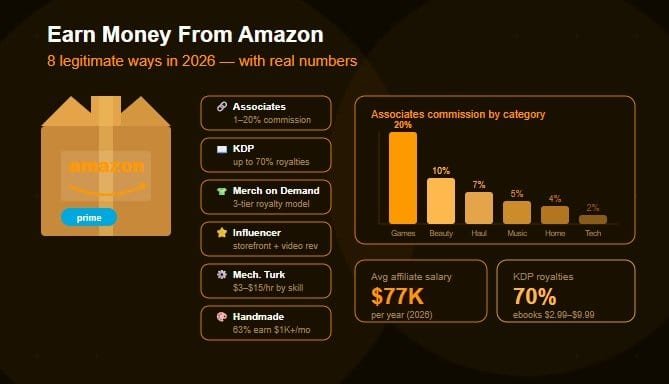
8 Legitimate Ways to Earn Money From Amazon (With Real Numbers)
In 2026, Amazon’s annual revenue has surpassed $620 billion, and the ecosystem of income opportunities it offers to individuals has grown proportionally more complex, more competitive, and in some cases more lucrative, and in others significantly less so than the 2020 guide suggested.
The biggest problem with most “earn money from Amazon” guides — including the previous version of this one — is the absence of real numbers. They list programs without telling you what the commission rates actually are, what the realistic earnings look like for most participants (not the outliers), or where the specific catch in each program is. This guide fixes that.
Here are eight legitimate ways to earn from Amazon in 2026, with the numbers that actually matter.
1. Amazon Associates (Affiliate Program) — The Most Accessible Starting Point
Amazon Associates remains one of the most beginner-friendly online income programs in existence — free to join, no inventory required, immediate access to hundreds of millions of products. The question isn’t whether it works; it’s whether it works for the category you’re in, because the commission structure is wildly uneven across product types.
The 2026 commission rates by category — the specific numbers the original post never mentioned:
- Amazon Games (digital): 20% — the highest rate on the platform
- Luxury Beauty, Amazon Explore, Handmade: 10%
- Amazon Haul: 7%
- Digital/Physical Music, Digital Videos: 5%
- Home & Kitchen, Outdoor, DIY: 3–4.5%
- Electronics, Computers: 2–3%
- Grocery, Health: 1–4%
- Video games (physical), TVs: 2%
According to Shopify’s June 2026 Amazon Associates guide, the national average salary for an Amazon affiliate is $77,893 per year — but that figure is heavily skewed by high earners. Most new affiliates will earn modestly until they build traffic volume.
Two things about the program that most guides understate:
First, the 24-hour cookie is both a limitation and an advantage. Your link expires after 24 hours if the item isn’t purchased — but if your reader starts a shopping session through your link and adds anything to their cart, you earn commission on their entire order, not just the product you linked. A reader who clicks your kitchen gadget link and then buys a $400 laptop in the same session earns you commission on the full cart.
Second, category selection is the most important decision you make. A 2% commission on a $25 electronic item earns you $0.50 per sale; a 10% commission on a $120 luxury skincare product earns you $12 per sale. According to EarnifyHub’s 2026 commission rate analysis, the most effective affiliates prioritise earnings per click (EPC), not raw commission percentage — because a 4% category with high average order value and strong conversion rates often outperforms a 10% niche with low purchase intent.
The honest limitation: The program has a 3-sale requirement within 180 days of signup before your account is confirmed. If you don’t have an existing audience — a blog, a YouTube channel, a TikTok with traction — building enough traffic to meet that threshold is harder than the sign-up process suggests.
2. Kindle Direct Publishing (KDP) — Passive Income, But Volume Is the Model
KDP gives any author the ability to publish ebooks and print-on-demand paperbacks on Amazon and earn up to 70% royalties on ebook sales (for books priced between $2.99 and $9.99 in qualifying markets) or 35% outside that pricing band. Paperback royalties run lower, after printing costs.
The 70% royalty rate is genuinely generous compared to traditional publishing (typically 8–15% on cover price). The challenge is that most KDP authors earn a few hundred dollars per month, and the model that produces substantial income is almost universally based on volume — publishing multiple titles, typically in commercial genres (romance, thriller, cozy mystery, self-help, or non-fiction how-to), not literary fiction.
The “zero investment” framing in the original post is technically accurate — you can upload a Word document for free. In practice, the authors earning meaningful income are investing in cover design ($50–$300 per title), editing, and often advertising via Amazon Ads to get initial visibility. That’s not zero investment; it’s deferred investment.
Where KDP genuinely delivers for the right person: non-fiction authors who can write authoritatively on evergreen topics (personal finance, specific software, professional skills), and fiction writers willing to treat publishing as a production system rather than a single book.
3. Merch on Demand — Free to Start, But the Royalty Structure Changed in 2026
Merch on Demand (formerly Merch by Amazon) lets designers upload artwork that Amazon prints on t-shirts, hoodies, mugs, and other products only after a customer orders. No inventory, no fulfillment — you earn royalties each time a product sells.
The program is application-based and Amazon is selective about acceptance. Once accepted, you start with 10 design slots and unlock more as your sales accumulate.
What changed in 2026 that the original post couldn’t cover: Amazon moved from a flat-rate royalty to a three-tier Creator/Plus/Premium model, and the base tier (purely organic traffic) pays lower royalties than previous years. According to AMZ Prep’s 2026 Merch on Demand analysis:
- Creator Tier (organic traffic only): base royalty rate
- Plus Tier (≥15% of monthly unit sales from external sources): 2× Creator rate — on a $19.99 t-shirt, approximately $4.88 per sale
- Premium Tier (≥35% of monthly sales from external sources): 2.16× Creator rate — approximately $5.27 per sale on the same item
The implication: Merch on Demand is no longer a truly passive model at competitive royalty rates. To earn at Plus or Premium tier, you need to drive external traffic — social media, email, a blog — to your Amazon listings and track it via Amazon Attribution links. Sellers who build that external traffic channel earn competitive royalties; sellers treating it as purely passive see reduced returns.
Merch Titans’ 2026 royalty guide puts the practical verdict clearly: the platform remains excellent for zero-risk design validation and passive supplemental income, but it’s no longer the “upload and forget” model it was marketed as in 2020.
4. Amazon Influencer Program — The Most Underrated Opportunity for Content Creators
The original post covered the Influencer Program briefly. In 2026, it deserves a much fuller treatment because it has developed into one of the more genuinely accessible creator monetisation paths on the platform.
The Influencer Program gives approved creators a personalised Amazon storefront to curate product recommendations. Unlike Associates (which pays only when someone follows a specific link), Influencer storefronts also pay commissions when users browse and buy from your page — the same Associates commission rates apply.
The significant addition since the original post: Amazon Live and on-product video reviews. Influencers can now upload short video reviews directly to Amazon product listing pages, which play when shoppers visit those listings. When someone watches your video on a product page and then purchases, you earn a commission — even if they found the product independently through Amazon search, not through your social media.
This is a meaningful structural shift. Your content can earn commissions from shoppers who never follow you, never visit your storefront, and found the product through their own Amazon search — they just happened to watch your review video on the listing page. As Savings Grove’s 2026 Amazon income guide notes, this makes the Influencer Program particularly valuable for creators who produce detailed, honest product reviews, because the content earns repeatedly from Amazon’s own internal traffic.
Entry requirement: an established social media presence with consistent engagement — follower count matters less than engagement rate.
5. Amazon Mechanical Turk — Honest Expectations Required
MTurk was covered in the original post as a flexible side income opportunity, which is still accurate, but the original’s framing omitted the earnings reality most workers experience.
Here is the actual picture from EarnifyHub’s 2026 analysis of 500 active MTurk workers:
- New workers without strategy: $3–5 per hour
- Experienced workers using scripts and targeting high-value tasks: $8–12 per hour
- Top 10% of workers who treat it as a part-time job and stack qualifications: $15+ per hour on specific batch tasks
The $6–10 per hour range often cited is achievable, but only with deliberate strategy — specifically:
- Using MTurk Suite to filter for HITs paying above your minimum hourly threshold
- Using Turkopticon to avoid requesters with a history of unfair rejections
- Targeting batch HITs (image annotation, data categorisation, sentiment analysis) that can be completed rapidly in sequence, rather than individual surveys
- Working during U.S. daytime hours (9am–5pm ET) when the highest-volume tasks are posted
MTurk in 2026 is best understood as a skill-based micro-task economy, not a simple “anyone can earn $X per hour” opportunity. The platform’s core mechanic hasn’t changed, but AI has automated many of the simpler tasks that once formed the floor of available work, pushing the remaining well-paid HITs toward tasks requiring human judgement and niche qualifications.
If you have 2–3 hours per day and are willing to learn the tools, it’s a legitimate supplemental income. If you sign up, browse the default HIT feed, and accept whatever appears, you will earn near minimum wage or below.
6. Amazon Handmade — A Genuine E-Commerce Alternative to Etsy
Amazon Handmade gives artisans a dedicated marketplace within Amazon for genuinely handcrafted items. The application process screens for authenticity — mass-produced items are not eligible. In exchange, you get access to Amazon’s 310+ million active customer base and optional FBA fulfilment.
According to Valuedvoice’s 2025 Amazon income analysis, 63% of Amazon Handmade artisans earn over $1,000 monthly, with many reporting $100+ in daily sales. That’s a meaningful benchmark — it suggests the channel converts for artisans who invest in product photography, keyword-optimised listings, and consistent inventory management.
The “zero investment” claim in the original guide needs a caveat: Amazon Handmade charges a 15% referral fee per sale (versus Etsy’s approximately 6.5% combined transaction and listing fees). For lower-priced items, that fee structure significantly compresses margins. The trade-off is Amazon’s dramatically higher organic traffic.
7. Kindle Direct Publishing — Low Content Books and Non-Fiction How-To
This deserves a separate mention from general KDP because the strategy is different enough to warrant its own entry. Low-content books — journals, planners, notebooks, logbooks, activity books — require no writing skill, can be produced in design tools like Canva, and are published as print-on-demand paperbacks through KDP.
The market is competitive and the individual royalties are low (typically $1.50–$4.00 per sale after printing costs for a $9.99 paperback), but the model scales through volume: hundreds of titles across multiple niches, with Amazon Ads driving traffic to the best performers. For designers, this is the print-on-demand equivalent of Merch on Demand but with more product control and higher per-unit margin.
8. Amazon Vine (and the Honest Explanation of What It Is)
The original post listed Amazon Vine as a way to earn from Amazon. To be precise: Amazon Vine doesn’t pay cash. It gives approved top reviewers access to free products in exchange for honest reviews. The value is in receiving products — sometimes high-value ones — at no cost.
You cannot apply for Vine directly; Amazon invites reviewers based on reviewer ranking (helpfulness votes on your existing reviews) and review quality. If you’re already a prolific Amazon reviewer with a strong track record, Vine is a valuable perk. If you’re starting from scratch specifically to get Vine access, the path is long.
The more actionable adjacent opportunity: becoming a prolific, high-quality reviewer builds reviewer rank that eventually leads to Vine eligibility — and the review habit also directly supports the Influencer Program, since detailed review content on Amazon product pages is what earns ongoing commissions through that channel.
The One Principle That Cuts Across All Eight
Every income stream on this list rewards specificity over generality. The Associates affiliate who picks a tight niche and becomes genuinely knowledgeable about it outearns the one promoting everything. The KDP author who studies what sells in a specific commercial genre outearns the one writing whatever they feel like. The Merch on Demand designer who builds an external audience in a specific community outearns the one uploading generic designs.
Amazon’s scale means there’s room for specialists at every level. But the platform’s economics have matured enough that “zero investment” is accurate in terms of upfront cash, not in terms of time, learning, or focus. The programs that actually produce income in 2026 reward people who treat them like a business — even a small one — not like a passive side experiment.
Want help identifying which Amazon income stream best fits your skills and situation? Get in touch.