
The Reading Catastrophe
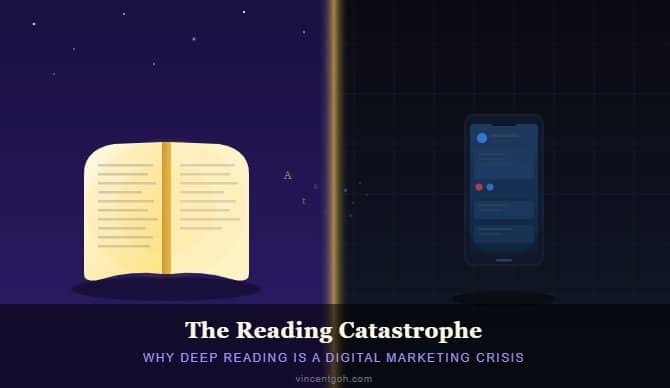
The Reading Catastrophe: Why the Death of Deep Reading Is a Digital Marketing Crisis in Disguise
Let me tell you something that should alarm every digital marketer, content creator, and online business owner reading this.
We are producing content for an audience that is rapidly losing the ability to read it.
Not because they are lazy. Not because they don’t care. But because a decade of dopamine-optimised social media feeds, 15-second TikToks, and algorithm-driven YouTube Shorts has quietly rewired the cognitive architecture of the very people we are trying to reach.
That distinction matters enormously to anyone building a digital business in 2026.
The Skill That Underpins Every Other Skill
Reading is not just one skill among many. Educator Michael Strong argues that if a child becomes a reader, roughly 80% of the education job is already done. Reading is the meta-skill — the operating system on which every other cognitive capability runs. History, science, mathematics, persuasion, critical thinking: all of them require the ability to read deeply and extract meaning from structured text.
For digital marketers, this is not abstract. It is the bedrock of everything we do.
Your email campaign requires reading. Your long-form sales page requires reading. Your SEO blog posts, your product descriptions, your social proof case studies — all of it depends on an audience that can engage with sustained written content. When HubSpot’s State of Marketing research consistently shows that long-form content outperforms short-form for lead generation and conversion, that finding assumes an audience capable of long-form engagement. That assumption is becoming less reliable with every passing year.
Your Brain on Reading vs. Your Brain on Video
Neuroscience has spent two decades building a case that reading and watching are not interchangeable experiences. They activate fundamentally different cognitive systems.
When you read deeply, you engage your visual cortex, your language areas, your motor cortex, your prefrontal cortex (the seat of critical thinking and inference), and your default mode network, which is where empathy and self-reflection live. Cognitive neuroscientist Maryanne Wolf, whose essential book Reader, Come Home is the definitive account of the reading brain, found that deep reading activates four to five major neural systems simultaneously.
Passive video consumption activates two: the visual cortex and the auditory cortex, with partial limbic engagement for emotional content. The prefrontal cortex — where your audience actually evaluates your offer, weighs your argument, and makes a decision — is largely disengaged.
This is not a marginal difference. For anyone trying to sell, persuade, educate, or build trust through content, this gap is the ballgame.
The Retention Illusion Is Killing Your Conversions
Here is the part that should keep you awake at night as a content marketer.
Video creates a powerful cognitive illusion: the feeling of having learned something. The production is polished, the presenter is confident, the graphics are slick. Your viewer arrives at the end feeling informed. But psychologists Henry Roediger and Jeffrey Karpicke’s research on the testing effect reveals the inconvenient truth. Passive video produces retention rates in the single digits after one week for conceptual material. Deep reading with active engagement retains 60–72% of core concepts.
The implications for digital marketing are significant. If your audience is consuming your video explainer about your product, but retaining less than 8% of it a week later, your remarketing campaigns are not just competing with your competitors. They are competing with your own content’s invisibility.
Reading, because it forces continuous active construction of meaning — integrating new information with existing knowledge in real time — is inherently more retrieval-like than viewing. Every paragraph requires mental work. That mental work is exactly what builds durable understanding of your brand, your offer, and your value proposition.
This is why Nielsen Norman Group’s research on web reading behaviour continues to show that users who engage with long-form written content convert at higher rates than those who primarily watch embedded video. They actually remember what they read.
The Friction-Reward Curve and What It Means for Content Strategy
There is a concept in cognitive science called Desirable Difficulties, developed by researchers Robert Bjork and Elizabeth Bjork at UCLA. The principle is counterintuitive but robust: the conditions that make learning feel harder in the short term produce dramatically stronger long-term retention and transfer.
Reading is a desirable difficulty. Video is not.
There is a threshold in reading — reached at roughly 10 to 15 minutes of sustained engagement — where the initial resistance dissolves and the reader enters a state of genuine absorption. Flow. The cognitive systems engaged by reading reach a level of activation that becomes self-sustaining. The effort converts into momentum.
This is precisely the state that dopamine-optimised content platforms are engineered to prevent you from ever reaching. Fifteen-second reels, 60-second YouTube Shorts, three-minute explainer videos: every format choice in the attention economy is calibrated to keep users permanently on the left side of that crossover point. Not because it serves the user. Because it maximises engagement metrics.
As a content creator, understanding this curve is your competitive edge. The readers who make it past that 12-minute threshold on your long-form piece are not just engaged. They are converted. They have crossed into absorption. Your content is no longer competing with everything else; it has become, temporarily, the entire world.
Backlinko’s analysis of Google’s top-ranking content consistently finds that long-form articles — averaging over 1,800 words — outperform shorter content significantly in organic rankings. Google’s algorithm is, at some level, measuring and rewarding the kind of deep engagement that only genuine reading produces.
The Class Divide Nobody Wants to Name (But Marketers Need to Understand)
Reading is becoming a class marker.
In households where adults read, where books are visible and valued, where children see reading modelled as a freely chosen behaviour — reading rates have declined less steeply. In households without that modelling, the smartphone filled the void completely. The consequence is a growing cognitive divergence that will compound economically over time.
The jobs most resistant to automation are precisely those requiring sustained reading capacity: complex reasoning, contextual judgment, the ability to navigate ambiguity. We are concentrating those capabilities in the children of people who already have them.
For digital marketers, this means something concrete about audience segmentation. Your highest-value customer segments — those with the purchasing power, the decision-making authority, and the long purchase consideration cycles — are disproportionately the people who still read. Your premium positioning, your detailed case studies, your long-form trust-building content: these are not just good SEO. They are the primary channel to the audience that converts at the highest lifetime value.
Brands that are migrating entirely to short-form video content in pursuit of reach are optimising for the audience with the lowest long-term conversion potential. That is a strategic error worth naming clearly.
Can the Reading Habit Be Rebuilt? (And Should You Care?)
The neuroscience of neuroplasticity offers genuine encouragement here. The reading brain can be rebuilt in adulthood. Adults who commit to sustained reading — actual linear reading of long-form text, for at least 30 minutes daily, without a phone in the room — can recover significant deep reading capacity within 12 to 18 months of consistent practice.
For your audience, this matters. For your own competitive advantage as a marketer, it matters more.
The marketers who read widely are building a fundamentally different cognitive infrastructure than those who primarily consume content through video and social feeds. They are developing richer vocabulary — which means more precise messaging. They are exercising their inference muscles — which means sharper audience insight. They are practising sustained concentration — which means better strategy.
Ryan Holiday’s work on the reading habits of history’s most effective leaders is instructive here. The pattern is consistent across fields and centuries: the people who move the world forward are almost universally voracious readers. Not because reading is virtuous. Because it is the most efficient technology ever invented for downloading another mind’s best thinking directly into your own.
What This Means for Your Content Strategy in 2026
The reading catastrophe is real. It is accelerating. And it creates a genuine opportunity for digital marketers willing to think clearly about what is actually happening.
Here is the strategic picture. As short-form video proliferates and the average content consumer’s deep reading capacity atrophies, genuinely excellent long-form written content becomes rarer and therefore more valuable. The marketer who can write a 2,000-word article that pulls a reader past the absorption threshold is not competing in the same game as the person churning out 60-second reels.
The audience that reads is smaller than it was twenty years ago. It is also better educated, more affluent, more likely to be a decision-maker, and more likely to remember what they read a week later. That is the audience that builds businesses.
Read more. Write better. Go long.
Not because it is old-fashioned. Because it is the highest-leverage thing you can do in a content landscape where everyone else is racing in the opposite direction.