
How to Turn Your Online Charisma Into Real Cash
The X-Factor Economy: How to Turn Your Online Charisma Into Real Cash
Let me ask you something uncomfortable.
You scroll through your feed every day and watch someone — not particularly smarter than you, not necessarily better-looking — rack up hundreds of thousands of followers, close brand deals, and build a business that earns while they sleep. And you think: what do they have that I don’t?
It’s not production quality. Some of the biggest creators film in their car with a phone propped on the dashboard. It’s not credentials. Many of them dropped out, pivoted careers, or started with zero audience. It’s not even luck, though people love to blame luck when they can’t identify the real ingredient.
What they have is an X-factor. And in 2026, that X-factor has a name, a science, and — here’s the part nobody told you — a price tag.
“Attention is cheap. Trust is rare. And charisma is just trust you can feel.” That sentence is worth sitting with for a minute because it reframes everything about how we think about digital marketing.
Charisma Is Not What You Think It Is
Most people treat charisma like height — you either have it or you don’t. That assumption is both wrong and expensive, because it stops you from developing the single most monetisable skill in the digital economy.
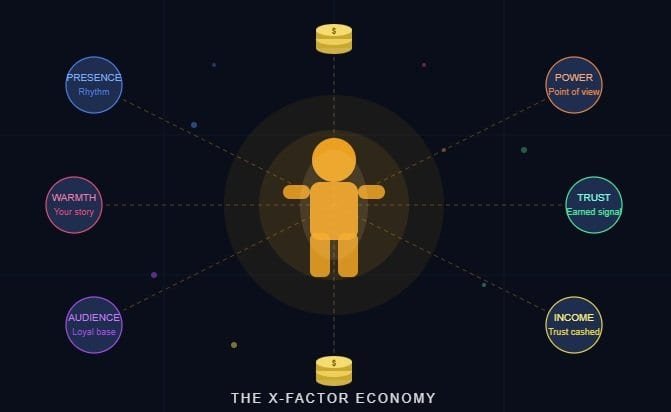
Olivia Fox Cabane, whose research has been widely cited in leadership and communication circles, breaks charisma down into three learnable components: presence, power, and warmth. These aren’t personality traits you’re born with. They’re signals you consciously transmit — and they work differently depending on whether you’re in a room or on a screen.
Here’s the catch that most digital marketing advice ignores: the classic rules of charisma — eye contact, mirroring body language, remembering names, smiling — are room skills. They assume a physical body across from another physical body. Research even suggests that a first impression forms in as little as a tenth of a second, and most of that signal is non-verbal.
Online, the body disappears. The room is gone. So what carries the charisma?
The three forces don’t die — they transform:
- Presence becomes rhythm. Consistency across weeks and months until strangers feel like they know you. This is the mechanism behind every creator who built a loyal audience from scratch.
- Power becomes a point of view. You say the thing. You take the position. You risk being wrong publicly.
- Warmth becomes self-disclosure. The story. The scar. The moment you sound like a real person instead of a brand account.
When you understand this translation, you stop trying to “go viral” and start building something far more durable: a human signal that an algorithm is forced to carry.
Why the Creator Economy Has Never Been More Valuable — or More Competitive
Here’s the broader context that should make every digital marketer pay attention.
Trust has quietly migrated away from institutions and toward individuals. The 2026 Edelman Trust Barometer finds that roughly half of consumers now trust influencers — and many would extend that trust to a brand they actively distrust, simply because the right person vouched for it. That’s extraordinary. A single authentic voice can override years of brand marketing.
The money followed the trust. Goldman Sachs projects the creator economy will approach $480 billion by 2027 — roughly double its current size. Fifty million people now identify as creators.
But here’s the sobering truth that gets buried in the hype: only around 4% of creators earn a full-time living from their content. The other 96% produce content that looks like everyone else’s, gets a polite algorithmic shrug, and eventually burns out.
The difference between the 4% and the 96% is not talent, effort, or even strategy. It’s signal strength. The 4% have a charisma that cuts through the noise. The 96% are indistinguishable from each other — and increasingly, from AI-generated content.
The Sameness Machine Is Your Real Competition
Let’s talk about what’s eating your differentiation.
Algorithms reward predictability. They surface what already worked, creating a gravitational pull toward templates, trending formats, and safe topics. And now AI floods those same channels with content that is technically competent and completely forgettable.
Here’s what makes this particularly dangerous: research comparing virtual AI influencers to human creators consistently finds that audiences rate AI-generated personalities lower on authenticity and emotional connection — even when the AI content is objectively more polished.
People can feel the difference. They can’t always name it, but they feel it. And that feeling — or the absence of it — determines whether someone scrolls past you or subscribes.
The machine can copy your format. It cannot copy your human signal.
The test is simple: if your best piece of content this month could carry someone else’s name and nobody would notice, you’ve already been absorbed by the algorithm. You’re renting someone else’s template instead of owning your own voice.
Three Creators Who Proved the Model
Theory is cheap. Let’s look at what this actually looks like in practice.
Emma Chamberlain built warmth into a business empire. She refused polish. Jump cuts, authentic anxiety, the mundane stuff of being a real teenager — that was her content strategy. That warmth became so commercially valuable that Chamberlain Coffee reportedly moved a million dollars of product in its first 30 minutes, and luxury brands like Cartier came calling. She didn’t sell coffee. She sold trust, and attached coffee to it.
Alex Hormozi turned power into a nine-figure business. Where most “gurus” lock their best content behind a paywall, Hormozi gives the entire playbook away for free — pricing frameworks, sales scripts, business models, all of it. The generosity builds trust at scale. The trust feeds Acquisition.com, where he takes equity stakes in the businesses that come to him already believing in him. The lesson: the more you give away, the more you’re trusted with.
Ali Abdaal turned presence into a diversified income machine. He didn’t quit medicine to chase fame. He just showed up — week after week, consistently, calmly — sharing study tips and personal development insights while working hospital shifts. Today his courses far outpace ad revenue as his primary income stream, and his book became a bestseller. Production quality was irrelevant. What mattered was showing up so consistently that he became part of people’s routines.
Three different niches. Three different signals. One common pattern: none of them chased the algorithm. They built something the algorithm was forced to carry.
The Five-Step Charisma-to-Cash Framework
So how do you actually do this on purpose, as a digital marketer or creator building a business? Here’s the framework in order. Skip a step and you’ll wonder why it isn’t working.
Step 1: Find your signal. What part of you cannot be replicated by AI? Your specific combination of experiences, obsessions, and perspectives is unique. Your story, your scars, your unconventional takes — that’s your raw material. Start by asking: could an AI have written this? If the answer is yes, it’s noise. If the answer is “only if they lived exactly my life,” you’re on to something.
Step 2: Build presence through rhythm, not virality. Pick one platform where your audience lives. Show up every week, without exception, for at least a year. Boring-but-present beats brilliant-but-absent. Consistency is what converts a stranger into a follower and a follower into a reader who actually remembers your name. That process is also known as building parasocial trust — and it’s one of the most commercially powerful forces in the digital economy.
Step 3: Earn trust by giving your best away. Be the most generous expert in your corner of the internet. Answer the question fully, don’t tease. Give the framework, not just the headline. Most people are afraid to give away too much. That fear is exactly where your competitive advantage lives. Generosity at scale is the fastest trust-builder available.
Step 4: Build something you own. This is where most creators plateau. Brand deals and sponsored posts mean renting your audience to someone else. According to Goldman Sachs, the average creator draws nearly 70% of income from brand partnerships — essentially a landlord-tenant relationship where you don’t own the building. Owners build their own products: a course, a community, a SaaS tool, a newsletter, a consulting offer. Rent pays this month. Ownership pays for years.
Step 5: Convert trust into income with the right offer. Revenue is just trust, cashed in at the right moment. When your signal is real and your offer matches what your audience actually needs, selling stops feeling like selling. Don’t lead with the ask. Earn the right to make it first.
What This Means for Digital Marketers in 2026
If you’re building a personal brand, running a business account, or advising clients on their content strategy, this is the framework that matters now.
AI will continue to flood every channel with competent, forgettable content. The algorithmic pressure to be generic will only increase. The creators and brands that survive — and scale — will be the ones who choose to be unmistakably themselves.
Your X-factor is not a nice-to-have. It’s the primary defensive moat against commoditisation. In an attention economy drowning in sameness, the rarest resource is a human signal strong enough to remember.
Stop trying to be findable. Start being unforgettable.
Build the signal. Earn the trust. Own the asset.
The charisma-to-cash ladder isn’t a theory. It’s a framework that has already made a generation of creators wealthy. The only question is whether you’ll use it before everyone else catches on.