
10 Social Media Techniques That Actually Work
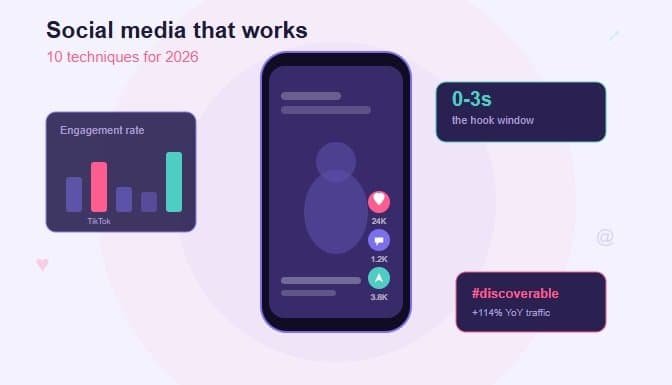
10 Social Media Techniques That Actually Work (Backed by Data, Not Vibes)
Generic social media advice has a shelf life of about six months before it becomes actively misleading. “Post consistently.” “Know your audience.” “Engage with your community.” All true, all useless without the specifics of how the platforms actually work right now — and right now, they work very differently than they did even eighteen months ago.
Three shifts make 2026 a genuinely different landscape from the “best practices” most lists still recite. First, social platforms have become search engines — nearly a third of consumers, and over half of Gen Z, now bypass Google entirely in favour of searching TikTok, Instagram, or YouTube directly. Second, the algorithms themselves have gotten dramatically better at understanding content without relying on the signals we used to optimise for — hashtags, follower count, posting time. Third, social commerce has become a $1.09 trillion market where 78% of purchases now happen without the user ever leaving the app.
Here’s what actually moves the needle given all of that.
1. Stop Guessing Your Goals — Tie Them to Platform-Specific Mechanics
“Define SMART goals” is true but empty advice on its own. The more useful version in 2026: your goal should determine which platform-specific signal you’re optimising for, because each major platform now rewards a different behaviour.
LinkedIn’s 2026 algorithm prioritises saves, comments, and shares over likes — it’s explicitly built to reward content that drives “meaningful professional engagement,” not popularity contests. TikTok rewards watch time and completion rate above everything else. Instagram increasingly rewards Reels distribution specifically — brands posting fewer than four Reels per week see 23% lower overall account reach.
Actionable shift: Don’t set one engagement goal across all platforms. Set a save/share target for LinkedIn, a completion-rate target for TikTok, and a Reels-frequency target for Instagram. Generic “engagement” tracking obscures which lever you’re actually supposed to be pulling on each platform.
2. Audience Research Now Has to Account for Social Search Behaviour
Knowing your audience’s demographics and interests is still foundational — but in 2026, you also need to know what they’re searching for on each platform, because TikTok, Instagram, YouTube, and Pinterest are functioning as default search engines for a huge share of younger users.
This changes how you should think about content planning. It’s no longer just “what does my audience like” — it’s “what would my audience type into TikTok’s search bar to find a business like mine.” Use the autocomplete suggestions in each platform’s native search bar as free, real-time keyword research. If you’re not showing up when someone searches your category on TikTok or Pinterest, you’re invisible to an entire discovery channel that has nothing to do with the For You algorithm.
3. Profile Optimisation: The Bio Matters Less Than the First Three Seconds
Profile basics (clear photo, consistent branding, a working link) are still table stakes, but the bigger 2026 shift is what happens the moment someone lands on your content, not your profile. Across every short-form platform, retention in the first three seconds now matters more than follower count for whether your content gets distributed further.
TikTok in particular now tests every video with a small audience segment before deciding whether to push it wider — your profile’s history and follower count barely factor in. A new account with a strong three-second hook can outperform an established one with a weak opening. This is a genuine structural change from a few years ago, when consistent posting volume alone could compound into algorithmic favour.
Practical takeaway: Spend disproportionate effort on your video’s opening frame and first line, not your bio. The bio gets you a follow; the hook gets you the view that makes the follow possible.
4. Content Strategy: The 80/20 Rule Still Holds, But Format Allocation Now Matters More
Mixing valuable and promotional content (the old 80/20 framework) remains sound, but in 2026 the bigger lever is format mix, not just content ratio. Short-form video — Reels, Shorts, TikTok — collectively accounts for 58% of total time spent on social media, but completion rates vary sharply by platform: TikTok holds 72% completion on sub-30-second content, versus 61% for Instagram Reels and 54% for YouTube Shorts.
That gap matters because it tells you these platforms reward genuinely different pacing — a video edited for TikTok’s attention span will often underperform if simply reposted to YouTube Shorts without adjustment. Repurposing without re-editing is increasingly penalised: TikTok specifically devalues content it detects as reused or reposted, prioritising original, platform-native uploads.
Practical workflow: Treat your core video as a source asset, not a finished product. A 60-second TikTok can become a 30-second Reel, several 10-second Shorts, and a square clip for LinkedIn — but each version needs its own edit, captions, and pacing, not a straight resize.
5. Hashtags: Back From the Dead, But Used Differently
For the last few years, the safe advice was “hashtags barely matter anymore — focus on captions.” 2026 data complicates that. Metricool’s analysis of 2.3 million TikTok posts found that hashtag traffic grew 114% year-over-year, and posts with hashtags get roughly 5% more views and nearly 10% more interactions than those without.
The nuance: it’s not about volume or virality-chasing tags like #fyp anymore. What works is one to five specific, descriptive hashtags that help the algorithm correctly categorise your content — a home cook posting a pasta recipe gets more from #weeknightdinner than #fyp, because the algorithm uses the hashtag as a categorisation signal on top of its own AI analysis of your video’s audio, visuals, and on-screen text.
By platform in 2026:
- TikTok: 1–5 specific, descriptive hashtags (not generic virality tags)
- Instagram: still 5–10, mixed branded and niche
- LinkedIn: 3–5, industry-specific
6. “Best Time to Post” Matters Less Than Consistency and Reels Frequency
Generic posting-time charts (9am Tuesdays, etc.) have become close to noise. What the 2026 data actually supports is frequency and consistency thresholds, not time-of-day precision. Brands post an average of five times per week on Instagram and TikTok, and falling meaningfully below that — particularly in Reels specifically on Instagram — has a measurable reach penalty.
Scheduling tools (Buffer, Hootsuite, Later, Metricool) are still worth using, but their value in 2026 is less about hitting a magic hour and more about maintaining a frequency floor without daily manual effort. If you’re choosing between perfecting your posting time and simply hitting your weekly volume target, hit the volume target.
7. Engagement: Comment Quality Is Now a Ranking Signal, Not Just a Vanity Metric
Replying to comments and DMs is still good practice, but in 2026 it’s also become a direct algorithmic input. TikTok’s system explicitly weighs quality of comments, not just volume — discussion-generating comments are read by the algorithm as a stronger value signal than simple emoji reactions, according to Social Rescue’s breakdown of current ranking factors.
This means the old advice to “ask a question in your caption to drive comments” still works, but the follow-through matters more than ever: a thread of genuine back-and-forth in the comments now functions as a ranking signal in its own right, not just a nice-to-have community gesture.
8. Influencer Collaboration Has Shifted From One-Off Shoutouts to Repeatable Formats
Partnering with influencers and complementary brands remains valuable, but the format has matured. The brands seeing real results in 2026 are building recurring series and episodic formats with creator partners — not one-off guest posts or single shoutouts — because audiences increasingly come back for a format they recognise, not a single viral moment.
TikTok creators with under 100k followers now achieve average engagement rates of 7.5% — far outperforming Instagram’s 3.65% average — which means the micro-influencer opportunity that started a few years ago has only gotten stronger. You don’t need a celebrity partnership; you need a smaller creator whose audience genuinely matches yours, ideally in an ongoing arrangement rather than a single transaction.
9. Analytics: Track Retention and Save Rate, Not Just Engagement Rate
Engagement rate, follower growth, and CTR are still worth tracking, but they’re increasingly lagging indicators. The metrics that actually predict algorithmic distribution in 2026 are watch time, replays, saves, and shares — TikTok in particular treats replays and shares as much stronger value signals than likes.
If you’re still reporting success purely on engagement rate or follower growth, you’re measuring the outcome, not the input the algorithm actually optimises around. A/B testing remains valuable — but test against retention curves and save rates, not just which caption got more likes.
10. The Trends Actually Worth Watching in 2026
The “stay updated with trends” advice was always vague. Here’s what’s specifically worth your attention this year:
Social commerce is no longer optional for product businesses. With 78% of social purchases now happening natively in-app, brands still redirecting users to external product pages see 3.4x higher cart abandonment than those using native checkout (TikTok Shop, Instagram Checkout). If you sell physical products and haven’t set up native in-app checkout, you’re losing the majority of your potential conversions before they even leave the platform.
AI-generated content now requires disclosure on some platforms. Instagram is rolling out AI transparency labels that clearly identify AI-generated content. Authenticity isn’t just a buzzword anymore — it’s becoming a platform-enforced distinction, and audiences are responding accordingly: creators and brands that blend genuine storytelling with AI-assisted production are outperforming polished, obviously synthetic content.
Platform diversification is now a risk-management necessity, not just a growth tactic. No brand can safely rely on a single “hero” platform in 2026 — algorithm volatility, regulatory uncertainty around platforms like TikTok, and fragmented audience behaviour all make single-platform dependency genuinely risky, not just suboptimal.
The Bottom Line
Mastering social media in 2026 isn’t fundamentally different in spirit from a few years ago — strategy, consistency, and genuine value still win. What’s changed is the mechanics underneath those principles: the algorithms reward different specific behaviours than they used to, the platforms themselves have become search engines, and commerce has moved natively in-app.
Apply the technique-level specifics above rather than the generic version of each principle, and you’ll be optimising for what the platforms actually reward today — not what they rewarded when most of the advice you’ve read was written.