
What You Actually Need to Know About ePacket Shipping
What You Actually Need to Know About ePacket Shipping in 2026 (It’s Not What It Was)
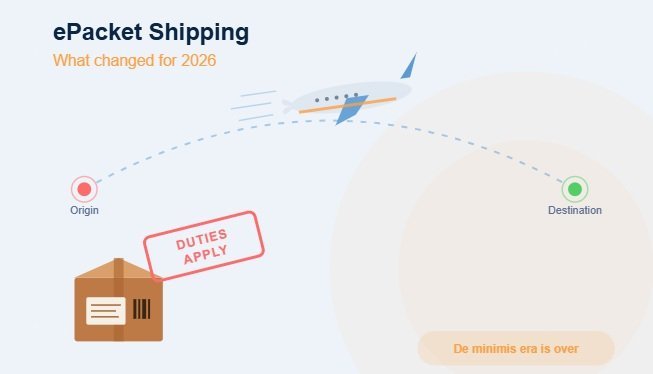
The de minimis exemption that made ePacket dropshipping cheap is gone. On May 2, 2025, the U.S. eliminated duty-free treatment for low-value shipments from China and Hong Kong, and on August 29, 2025, the exemption was suspended globally for all countries by executive order, per the official White House announcement. That single change rewired the entire dropshipping business model that ePacket was built to serve.
If you’re running, or thinking about starting, an e-commerce business that sources from China — this is the article you need to read.
What ePacket Still Is
The mechanics haven’t changed. ePacket remains a shipping service offered by merchants and postal operators in China and Hong Kong, designed for parcels under 2kg (4.4 lbs), with combined length, width, and height limits, available to more than 40 countries. According to Shopify’s current ePacket guide, it still offers end-to-end tracking and remains meaningfully faster than standard postal shipping.
What’s changed is coverage and cost, not the mechanism. A few specifics worth knowing:
- Japan was dropped from the ePacket network entirely in September 2023, according to World Population Review’s tracking of ePacket-eligible countries. If your market includes Japan, ePacket simply isn’t an option anymore — you’ll need an alternative carrier.
- The list of eligible countries fluctuates more than it did a few years ago, so check current eligibility before building a shipping strategy around it rather than assuming the 2018 list still applies.
- Delivery times remain in the 10–20 business day range for most destinations, occasionally stretching depending on customs load and the destination’s domestic postal capacity.
So far, this sounds like a minor update. It isn’t. The real story is what happens after the package leaves China.
The De Minimis Exemption Is Gone — And That’s the Whole Story Now
For over a decade, the thing that made ePacket dropshipping genuinely profitable wasn’t really the shipping speed. It was the fact that, under the U.S. de minimis rule, any shipment valued under $800 entered the country completely duty-free. Practical Ecommerce’s 2026 analysis traces this rule back to a 1930s convenience provision that ballooned in scale: de minimis shipments grew from 134 million in 2015 to over 1.36 billion in 2024, per White House data cited by Cleverific — and CBP was processing roughly 4 million such shipments per day at its peak.
That era is over. Here’s the actual timeline, which matters because the policy moved in stages and the details affect what you’re currently paying:
- February 2025: The exemption was first narrowed for goods that didn’t meet certain criteria, per AutoDS’s tracking of the policy.
- May 2, 2025: De minimis treatment ended specifically for China and Hong Kong. Low-value shipments from these two origins — which, per Congressional Research Service data cited by Cleverific, accounted for 67.4% of all U.S. de minimis imports between FY2018–2021 — became subject to full duties and formal customs entry.
- August 29, 2025: The exemption was suspended globally, for every country, not just China and Hong Kong, per executive order.
As of late 2025, per Avalara’s compliance tracking, Chinese imports face a stacked combination of tariffs — a reciprocal IEEPA tariff and a fentanyl-related tariff — that together can exceed 100% on select products, on top of the loss of duty-free entry itself. Tariff rates have moved repeatedly since the initial announcement and remain genuinely unsettled, so don’t treat any specific percentage as fixed; check current CBP guidance before pricing a product line.
What this means practically: the parcel that used to clear U.S. customs automatically and duty-free now goes through formal or informal entry processing, with duties calculated and collected. Your $8 phone case supplier item might now carry $4–10 in duties and processing fees on top of shipping — fees that didn’t exist in the model the original 2018 post (and most “how ePacket works” content still online) was written around.
What This Actually Means If You’re Running (or Starting) a Dropshipping Business
The honest answer is: the pure drop-from-China-direct-to-customer model that defined a decade of e-commerce content is now structurally less attractive than it was. That doesn’t mean it’s dead — it means the calculus has changed, and pretending otherwise will cost you margin.
1. Your unit economics need to be rebuilt, not patched. If your pricing model assumed duty-free entry, it’s now wrong. Easyship’s guidance on the transition is blunt about this: expect to pay duties, and expect to need to adjust retail pricing accordingly. Run your numbers again from scratch rather than assuming a small margin haircut will cover it.
2. Geographic diversification matters more than ever. Suppliers and sellers are increasingly looking at Vietnam, India, Mexico, and domestic U.S. fulfilment as alternatives, not because China-based sourcing has become impossible, but because the cost advantage that justified the complexity has narrowed. The-Future-of-Commerce’s reporting notes that dropshippers were already scrambling for alternative suppliers as the China-specific exemption ended in May 2025.
3. “Dropshipping goes local” is the actual emerging trend. Syncee’s analysis frames this clearly: with the duty-free advantage gone, the structural case for U.S.-based or near-shored fulfilment (domestic 3PLs, Mexico, Canada) has strengthened relative to direct-from-China shipping, because you’re no longer comparing “cheap-and-slow domestic” against “cheap-and-fast international” — you’re comparing two models that are now closer in landed cost, where the domestic option wins on speed and customer experience.
4. Bulk import + domestic warehousing is now more competitive, not less. Before 2025, many sellers chose ePacket precisely to avoid the upfront cost of bulk importing and warehousing inventory domestically. With duty exposure now hitting individual parcels too, the per-unit cost gap between “import in bulk, pay duties once, warehouse domestically” and “ship individually, pay duties on every parcel” has narrowed considerably — and bulk importing typically still wins on shipping speed and customer experience.
So Is ePacket Still Worth Using in 2026?
Yes, conditionally. It hasn’t been replaced as a mechanism — it’s still one of the more cost-effective and trackable ways to move small parcels internationally, and for businesses that aren’t shipping to the U.S., or that are shipping items already factored for duty exposure, it remains a reasonable option.
What’s no longer true is the implicit promise that made ePacket the backbone of an entire generation of dropshipping content: cheap, fast, duty-free delivery from a Chinese supplier straight to a U.S. customer’s door, with margin built on the assumption that customs would never touch the parcel. That promise is gone, and any supplier, course, or guide still selling that pitch without mentioning the 2025 de minimis changes is giving you outdated information.
Before building or continuing a China-sourced e-commerce business in 2026, confirm:
- Whether your target country still has de minimis treatment, and at what threshold (the U.S. now has none; check your specific market)
- Current applicable tariff rates for your product category — these have moved multiple times since 2025 and may move again
- Whether bulk import + domestic fulfilment now beats per-parcel international shipping on landed cost, not just on the assumptions you built your business on
- Whether your supplier’s quoted “ePacket shipping included” pricing has been updated to reflect duty collection, or whether it’s quietly leaving you to discover the gap at checkout
The underlying lesson is bigger than ePacket itself: trade policy is no longer a stable backdrop you can build a business model on without revisiting it. The smart move for 2026 isn’t finding the new version of the old loophole — it’s building unit economics that hold up regardless of which way policy moves next.