
7 Influencer Marketing Tactics That Drive Real ROI
Influencer Marketing: 7 Tactics That Drive Real ROI (And the Ones That Don’t)
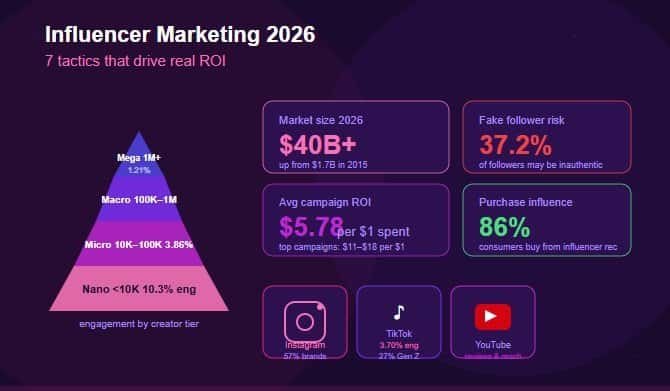
By 2025, the industry had tripled it again, reaching $32.55 billion — and projections for 2026 place it between $40.51 billion and $47.8 billion, with the broader creator economy expected to approach $820 billion by 2030.
The fundamentals from the 2019 post still hold: people trust creator recommendations more than brand advertising, and that trust converts to revenue. What has changed completely is the infrastructure, the tier economics, the fraud risk, the legal landscape, and the role of AI across the entire stack. The number of companies offering influencer marketing services has exploded from just 190 in 2015 to over 7,000 in 2025 — and yet 48% of marketers still cite “identifying, qualifying, and connecting with ideal influencers” as their biggest challenge.
More tools, more budget, and still the same core problem. This guide addresses that, with the specific tactics and data that actually separate campaigns delivering on the channel’s promise from the majority that don’t.
The ROI Case: What the Numbers Actually Say Now
The original post cited an average return of $6.50 for every $1 spent. The 2026 figure is $5.78 per $1 invested, with top-performing campaigns achieving $11–$18 per dollar through optimised targeting and performance tracking. The headline return has modestly compressed as the channel matured and pricing rose — but 83% of brands consider their influencer marketing efforts effective or very effective, and 82% of marketers say influencer-sourced leads are higher quality than other channels.
The more striking 2026 data point is B2B: B2B influencer campaigns deliver an 11× ROI compared to programmatic display ads, and 86% of B2B marketers plan to increase influencer budgets in the next 12 months. The 2019 post treated influencer marketing as essentially a B2C tool. That’s no longer accurate — LinkedIn creator partnerships and industry-expert collaborations are now among the fastest-growing segments in the category.
Tactic 1: Stop Optimising for Follower Count — Optimise for Engagement Tier
The 2019 post recommended micro-influencers in general terms. The 2026 data is far more specific, and it has moved the needle further down the tier ladder than most brands expected.
Micro-influencers (10K–100K followers) generate an average engagement rate of 3.86% compared to 1.21% for mega-influencers (1M+ followers) — and per-post costs are 60% lower. This performance gap is widening as audiences increasingly reward perceived authenticity over reach.
But it’s the nano tier that deserves attention in 2026. Nano-influencers now represent 75.9% of Instagram’s influencer base, and 44% of brands now prefer working with nano-influencers who have fewer than 10,000 followers. On TikTok, nano-influencers achieve engagement rates of 10.3% — a figure that makes most paid social benchmarks look anemic.
The practical implication: micro-influencers charge $100–$1,000 per Instagram post compared to $5,000+ for macro-influencers. A budget that buys one macro-influencer post can instead fund 10–50 nano and micro-influencer posts with meaningfully higher engagement rates. The math has shifted — and the brands running 2019-style single-macro-influencer campaigns are consistently underperforming versus brands running diversified creator rosters.
The counterpoint: Scale has its own logic. Macro and mega influencers still earn their place for product launches, cultural moments, and reach objectives where depth of engagement is less important than breadth of exposure. Many teams are keeping macro as a selective layer — used for credibility moments, launches, or reach spikes — while the program’s day-to-day output shifts to smaller creators and UGC-style production. That hybrid model is where most sophisticated programs are landing in 2026.
Tactic 2: Build Long-Term Partnerships, Not One-Off Posts
Half of influencers charge between $250–$1,000 per post, but 71% offer discounts for longer-term partnerships — and another 25% would consider doing so. That’s not just a cost saving — it’s a fundamentally better creative output. Long-term relationships give creators the time to integrate a brand into their content naturally, which produces more credible, higher-performing posts.
The 2019 post focused almost entirely on one-off campaign tactics. In 2026, the most effective influencer programs look less like individual campaigns and more like ongoing ambassador relationships — structured with clear KPIs, regular content cadences, and performance-linked compensation.
Performance-based compensation models now sit at 53% adoption, up significantly from the purely flat-fee structures that dominated 2019. Tying a portion of creator compensation to actual conversions or sales (tracked via unique promo codes, affiliate links, or UTM parameters) is now standard practice, not an edge case.
The brand that still reaches out to influencers transaction by transaction, post by post, is leaving both ROI and creative quality on the table.
Tactic 3: Make TikTok a Dedicated Line Item — Not an Instagram Afterthought
The 2019 post didn’t mention TikTok. That’s understandable — TikTok was still establishing itself outside of China. In 2026, ignoring it is a strategic error for any brand targeting audiences under 40.
While 15% of all consumers overall engage with influencers on TikTok, over a quarter (27%) of Gen Z engage with influencers on the platform. TikTok averaged roughly 3.70% engagement in 2025, up 49% year-over-year, compared to Instagram’s 0.48%. That 7× engagement multiple is the most important platform-level differential in influencer marketing right now.
Two caveats worth acknowledging: first, TikTok saw a 17.2% investment drop following U.S. ban concerns, which has pushed brands toward multi-platform strategies rather than TikTok-first approaches. Second, social commerce on TikTok is still maturing — 53.33% of influencer marketers are not currently using social commerce, while 46.67% are planning to test it in 2026. If TikTok Shop converts as a commerce vehicle for your category (it generated $500 million in sales over Black Friday/Cyber Monday 2025 alone), the investment case is strong; if it doesn’t, the organic content partnership case remains independent of the commerce question.
For most brands in 2026: the best platform depends on your target audience. TikTok excels for Gen Z audiences and offers the highest engagement rates; YouTube works well for detailed product reviews and tutorials with longer shelf life; LinkedIn suits B2B influencer campaigns. Most successful brands use a multi-platform approach tailored to where their customers spend time.
Tactic 4: Fraud Detection Is No Longer Optional Infrastructure
This tactic didn’t appear in the 2019 guide at all. In 2026, it’s one of the highest-leverage investments you can make in influencer marketing.
A SociaVault audit of 100,000 creator accounts found that about 37.2% of influencer followers showed signs of being fake, purchased, or inauthentic. Brands are losing an estimated 36% of budgets to fake engagement. In a channel where the average ROI is $5.78 per dollar spent, losing more than a third of your budget to fraud before a single real consumer ever sees your content is catastrophic.
Approximately six out of ten marketing professionals now utilise artificial intelligence within their creator operations, with AI functioning as a core operational utility for audience verification before deploying capital. Tools like IZEA, Modash, and Sprout Social Influencer Marketing now include AI-powered fraud detection that screens for fake follower patterns, engagement pod behaviour, and audience authenticity at scale.
The 2019 advice to “beware of fake followers” was correct but vague. The 2026 version is operational: screen every creator through an AI-powered verification tool before contracting, and treat a high fraud score as a disqualifier regardless of how attractive the rest of the creator’s profile looks.
Tactic 5: Run Contests and Gifted Collaborations Strategically — With One Twist
The original post’s recommendation to launch contests and giveaways with influencers remains valid. But 2026 data adds a counterintuitive insight worth knowing.
Gifted partnerships deliver 2.19% engagement rates, 12.9% higher than paid collaborations at 1.94% — particularly effective for early-stage brand-building. Creators who genuinely choose to try and post about your product because they received it for free often produce more authentic content than those executing a paid brief. The audience senses that difference.
This doesn’t mean paid partnerships underperform — at scale, paid partnerships are necessary infrastructure. But for product-based businesses testing influencer marketing for the first time, a gifted seeding program to 20–50 highly relevant nano-influencers can produce measurable results at a fraction of the cost of a single paid macro-influencer campaign, and the organic content it generates can then be amplified via paid media.
Tactic 6: Use Promo Codes and Affiliate Links — But Build the Attribution Layer First
Exclusive promo codes and affiliate links remain one of the most effective tools for both compensating creators and tracking campaign impact. That part of the 2019 advice hasn’t changed.
What has changed is that performance tracking is now table stakes, not a bonus. Measurement remains a structural constraint across the industry — measuring ROI and attribution complexity combined account for 15.84% of reported challenges, showing that even when teams invest, they still struggle to connect creator activity to outcomes in a way that holds up internally.
Build your attribution layer before you brief creators, not after. That means: UTM parameters on all links, unique promo codes per creator (not per campaign), pixel-based conversion tracking where your platform allows it, and a clear policy on how you handle multi-touch attribution when a customer sees both an influencer post and a paid ad before converting.
Tactic 7: FTC Compliance Is Now an Operational Requirement, Not a Footnote
The 2019 post didn’t address disclosure requirements at all. In 2026, running an influencer campaign without a clear compliance framework is a legal and reputational risk that no marketing team can afford to ignore.
The Advertising Standards Council of India processed 1,609 influencer violation cases in 2025–2026 alone, with 97.3% of reviewed ads requiring modification or takedown due to inadequate disclosure or misleading claims. The FTC in the U.S. has issued updated guidelines that require clear and conspicuous disclosure of all material connections — including gifted products, affiliate relationships, and paid partnerships — in a location viewers actually see, not buried in hashtag lists.
The practical standard in 2026: every piece of sponsored content, regardless of format, platform, or influencer tier, must include an explicit disclosure that a reasonable viewer sees before engaging with the content. “Partner,” “ad,” “sponsored,” or #ad at the beginning of a caption or spoken aloud in the first seconds of video are all acceptable. A #sponsored buried at the end of a long hashtag string is not.
Brief your influencers on disclosure requirements as part of every campaign contract. The creator who doesn’t disclose creates legal exposure for your brand, not just for themselves.
The One New Development Worth Watching: Virtual Influencers
The 2019 post couldn’t have anticipated this, but it’s too significant to omit. AI-generated virtual influencers have grown into an $11.74 billion market, expanding at a CAGR of 41–44.8%, with projections putting it at $154–$184 billion by 2032. 34 Fortune 500 companies launched dedicated virtual influencer divisions in 2025.
The operational case is clear: virtual influencers need no travel, no stylists, no contract negotiations; they generate content 24/7 across time zones and languages; per-post production cost runs 38% lower than human creators; and they eliminate the “controversy risk” tied to unpredictable human behaviour.
Whether virtual influencers are right for your brand in 2026 depends heavily on your audience and category. For Gen Z audiences who grew up with digital-native culture, they’re increasingly accepted. For categories where human authenticity is the core of the value proposition — health, personal finance, mental wellness — the human creator advantage remains significant and unlikely to erode quickly.
The Bottom Line
In 2019, the entry bar for influencer marketing was low — find someone with a following, give them your product, and post. In 2026, the channel has professionalised. Fraud is a real budget risk. FTC compliance is mandatory. Attribution requires actual infrastructure. And the ROI data consistently points toward nano and micro creators, long-term partnerships, and performance-linked compensation over the celebrity-partnership model that once defined the category.
The channel’s core insight — that people trust real people more than brands — hasn’t changed. The sophistication required to act on that insight effectively has changed dramatically.
The brands winning in this space are not the ones spending the most. They are the ones spending precisely, tracking rigorously, and adapting to where the engagement, trust, and ROI data is actually pointing.
Want help building an influencer marketing strategy grounded in 2026 data? Get in touch.